


How a 118-year-old idea from probability theory explains coin tosses, combat, board games — and why 87% of people get a simple question catastrophically wrong.
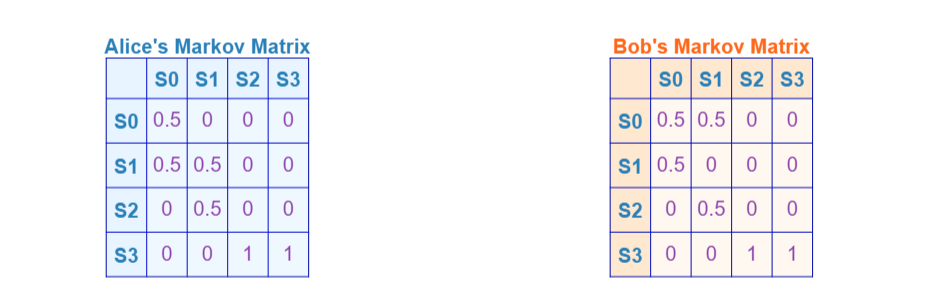
Imagine two volunteers, Alice and Bob, each holding a fair coin. Alice keeps tossing until she sees a Heads immediately followed by a Tails — the pattern HT. Bob keeps tossing until he sees two consecutive Heads — the pattern HH. On average, who needs more tosses to reach their target?
Most people — about 77% of respondents — said they’d take the same number. The reasoning feels airtight: both patterns are two flips long, the coin is fair, so any two consecutive flips are equally likely to be HT or HH. It seems like a wash.
It isn’t. Alice finishes in an average of four tosses. Bob needs six. Same coin, same length pattern, same probability of appearing in any given pair of flips — and yet Bob takes 50% longer. How is that possible?
The answer lies in one of the most elegant and powerful ideas in all of mathematics: the Markov Chain.
A Markov Chain is simply a way of describing a system that moves through a series of states based on random events. At each state, something random happens — a coin flip, a die roll, a price movement — and depending on the outcome, the system transitions to a new state. The crucial property is that the next state depends only on where you are now, not on the full history of how you got there. The past is irrelevant. Only the present matters.
Andrey Markov formalised this idea in 1906. Today, Markov Chains power Google’s PageRank algorithm, model DNA sequences in genetics, drive speech recognition software, and sit at the heart of options pricing models. Once you learn to see the world through this lens, you find Markov Chains hiding inside all sorts of familiar things — including, as we’ll get to, a children’s board game.
If you want to read more about Markov please check the article below :
The Markov Imperative

This deep dive reveals how a 19th-century mathematician's vendetta against theological determinism birthed the algorithms now steering container ships through pirate waters and predicting cocoa price explosions.
