


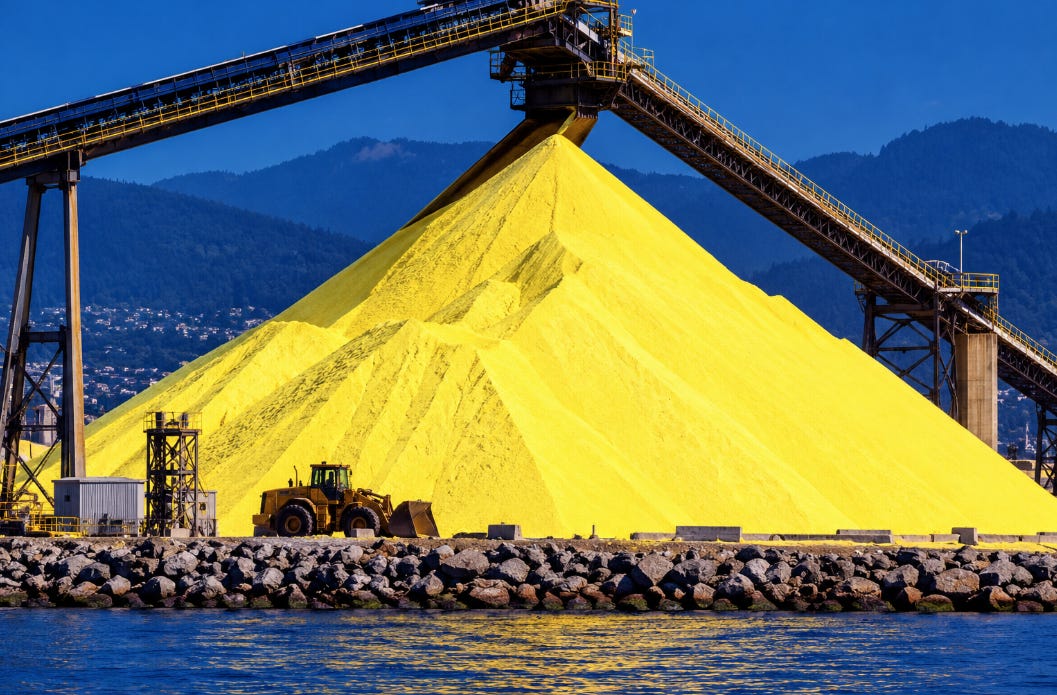
Russia, the world’s second-largest crude exporter, spent the summer buying gasoline from India through Egyptian transshipment hubs, and Deputy Prime Minister Novak says it will keep doing so at least until year-end, at a steady tenth of the domestic market (TASS). In the same fortnight Washington agreed to buy Russian diesel: more than 300,000 tonnes immediately, 500,000 in November and a million after that (Ynet). Meanwhile Vladivostok was taking diesel from South Korea. And in September, with Brent elevated by the Gulf, Moscow’s oil and gas take fell 22% year on year. Each of those facts looks like a contradiction. Read together, they are a chemistry lesson, and the cleanest illustration I have seen this year of a rule I keep coming back to: raw resources are worth surprisingly little on their own. Value accrues to whoever owns the conversion step, whether that is uranium enrichment, heavy-oil upgrading, subsea gas hardware, sour-gas sweetening or ammonia synthesis, and a producer without that step sells near cost to the one buyer who has it.
Put in our language, a reserve in the ground is a deep out-of-the-money call, and the strike is technology. Commentators love to rank countries by barrels and tonnes in the ground, as if the reserve were the asset. It is not. So let me walk through a handful of commodities, the physical chemistry that actually creates the value in each, and who ends up holding the in-the-money leg.
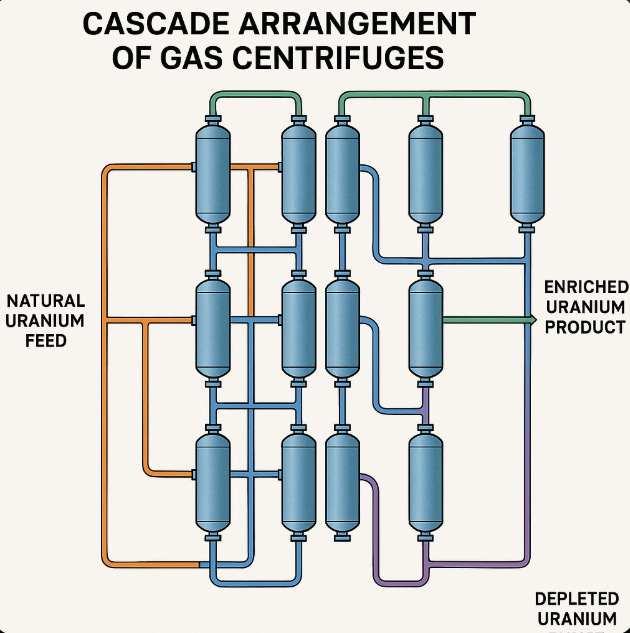
Start with uranium, where the gap between resource and product is starkest. Reactors consume around 62,500 tonnes of uranium a year, about 162m lb of U3O8, which at a spot price in the mid-$80s comes to roughly $14bn; industry estimates for 2025 put the whole ore market near $10bn (Skillings). Some 2,700 TWh of nuclear output valued at $100–170/MWh is worth $270–460bn, so the ore is roughly a thirtieth of the electricity it ends up as. The reason is isotopic. Natural uranium is 0.711% U-235 and a light-water reactor wants 3–5%, and the road between the two is three industrial steps of which none involves a shovel. Yellowcake is dissolved in nitric acid, purified by solvent extraction, reduced to UO2 and fluorinated into uranium hexafluoride, which sublimes at 56.5 °C and is therefore the only practical uranium compound you can push around as a gas. That gas then spins through cascades of centrifuges; the mass difference between the two isotopic forms of UF6 is under one percent, so each stage separates almost nothing and you need thousands of them, measured in separative work units. The enriched product is converted back to oxide, pressed and sintered at around 1,700 °C into ceramic pellets and sealed into zirconium-alloy rods built for one specific reactor design.
