A friend of mine who follows the Middle East more closely than I follow my own margin calls sent me a voice note the other night, half exhausted, half delighted with himself, the way people get when they’ve been proven right about something nobody wanted to hear. He’d just landed in Moscow after two sleepless nights near his dacha (summer house), which now has an air-defense battery parked next to it — the kind of detail that used to sound like satire and now just sounds like Tuesday. He wanted to talk about the funeral. Millions of mourners, a number so large it apparently broke a record set by the previous funeral of the same institutional office, and a crowd whose mood toward Washington and Tel Aviv was, in his words, not exactly diplomatically calibrated. But he didn’t really want to talk about the funeral. He wanted to talk about something else, a story spoken in barrels instead of tears.
Here is the shape of it, stripped of the theatrics. Sometime this spring, under pressure that had less to do with genuine appetite for peace than with the simple fact that everyone’s inventories needed refilling, a memorandum got signed. Call it Versailles with tankers instead of reparations. The framing, delivered by the Vice President with a straight face, was that buying time was itself the strategic objective — global inventories were thin, prices were doing things nobody’s P&L wanted to explain to a risk committee, and a pause, any pause, would let the system exhale. Iran, for its part, sold roughly eighty million tons of crude in the run-up, took delivery of a chunk of it back in physical cash rather than paper promises, restocked reserves through channels that included, amusingly, rail interconnects with Pakistan they mostly didn’t bother using, and generally played the compliant, deal-making counterparty. The first clause of that memorandum — and I want you to sit with this, because it’s the entire ballgame — assigned Iran, and only Iran, responsibility for the security and functioning of transit through the Strait of Hormuz. Not the Gulf monarchies. Not the U.S. Navy. Iran.
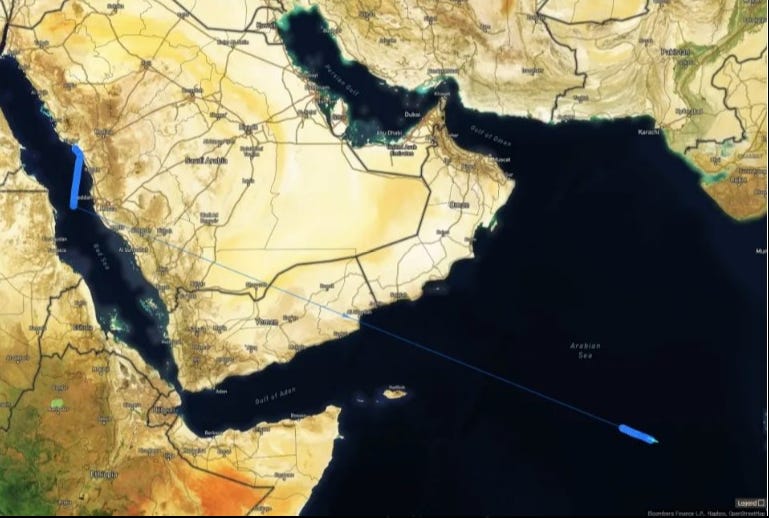
You’d think a clause like that would be sacred. It lasted about as long as it takes to say “sacred” out loud. Within days the same administration that signed it was quietly organizing a parallel shipping corridor along the Omani coast — the southern side of the strait — explicitly outside the lane Iran had just been handed sole custodial responsibility for. If you know anything about how territorial optionality gets priced, you’ll recognize what happened next as inevitable rather than surprising: you don’t hand a counterparty exclusive rights to a chokepoint and then unilaterally carve out a competing route through the same chokepoint without that counterparty reading it as a breach. Iran read it as a breach. Then, on the eighth and ninth of the month, they stopped warning and started firing anti-ship missiles — not the drone harassment everyone had priced in as background noise, actual guided ordnance — and put five vessels on the seabed or close to it in a single day. Four tankers, one dry bulk carrier. The convoy the U.S. had organized, largely composed of Emirati, Qatari, and Saudi tonnage, got vaporized as a demonstration rather than degraded as a nuisance.
What I find genuinely elegant about the whole sequence, in the way you find a well-constructed options strategy elegant even when it’s the strategy that’s about to take your money, is the logic of timing. Iran let two weeks of stated troop withdrawal orders sit on the books, let the world watch American forces notionally drawing down from the region after whatever earlier round of strikes had already happened, and then, four days before the funeral crowds even finished dispersing, watched Washington quietly reverse that withdrawal order and redeploy everything right back. Meanwhile Iranian strikes were clearing out every adjacent U.S. and allied basing option — Jordan included — funnelling all that redeployed hardware into a single geographic basket: Israel. If you’re running the Iranian side of this and your objective is to manufacture a clean casus belli against Israel itself, you don’t want American assets scattered across six bases. You want them concentrated in exactly one place, so that when you eventually strike, you get to claim you were striking a legitimate military target being used to stage attacks against you, and Israel eats the retaliation instead of hiding behind extraterritorial ambiguity. It is, and I don’t say this lightly, a beautifully constructed trap, and the fact that Israel’s own government reportedly told Washington not to bother redeploying aircraft to Ben Gurion tells you the Israelis saw the same trap and didn’t love being the designated collateral.