



Look at outright WTI or Brent and you’d think things are merely tight. Look at the cost of getting a barrel from where it sits to where it’s needed, and you realize the oil market has quietly outsourced its crisis to the freight desk. And then look at who’s supposed to be managing the demand side of that crisis — the European Union — and you realize the deeper problem isn’t tanker rates at all. It’s that the entity meant to coordinate a continental response to an energy shock was never built to do that job in the first place.
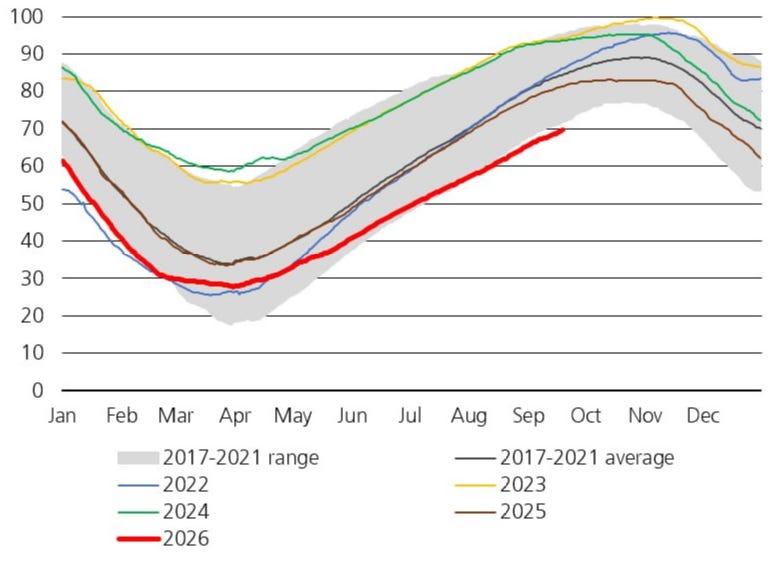
Start with the physical picture, because it’s the part you can trade. European gas storage sits at 69.6% full heading into the last week of September, meaningfully behind every prior year on the same chart, with Germany at 56.6% and the Netherlands at 55.1% doing most of the damage to the average. Austria’s at 67.6%, Spain 73.4%, France close to 80%, Italy the overachiever at 85.5%. Nobody’s in crisis yet. But the cushion going into winter is thinner than usual, and thin cushions have a way of turning ordinary cold snaps into headline events. File this under “background variable that raises everyone’s hedging beta.”
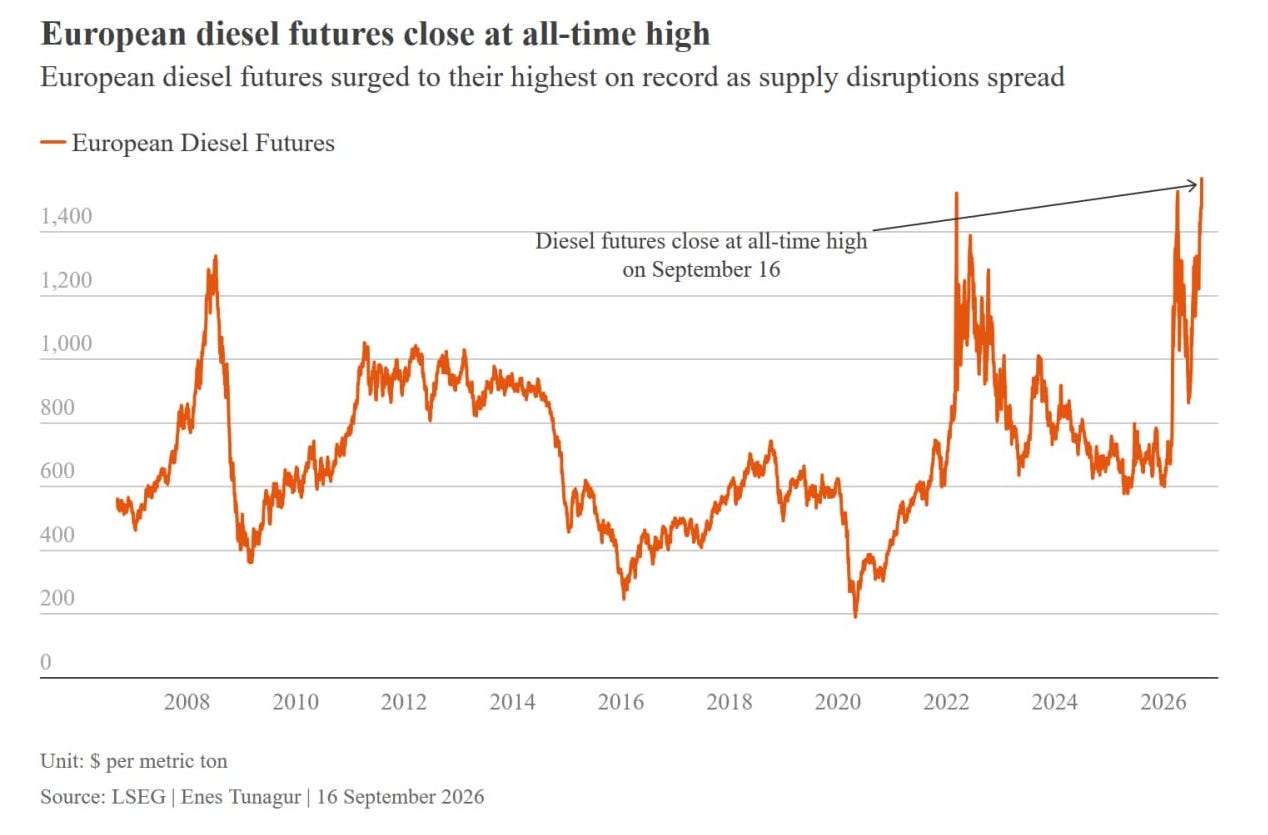
The story with actual teeth is diesel. European gasoil futures closed last week at an all-time high, more than doubling since the start of 2026. The mechanism fits on a napkin: wars in Iran and Ukraine have hit export capacity across Russia, Saudi Arabia and the UAE simultaneously, refinery infrastructure has taken damage on top of that, and the Middle East — which supplied roughly 41% of Europe’s diesel imports in 2025 — has seen its exports to Europe roughly halve since March, down to around 800,000 bpd. A meaningful share of what Saudi Arabia does still manage to ship has to thread the Red Sea. There is essentially no idle refining capacity anywhere willing and able to backfill that gap on short notice. When the marginal barrel of diesel has no substitute, you don’t get a price move, you get a price event — and the crack spread reflects it: the US heating oil crack is at levels last seen in 2009. That’s not refiners having a good quarter. That’s the market telling you refining capacity itself, not crude, is now the scarce input.
