


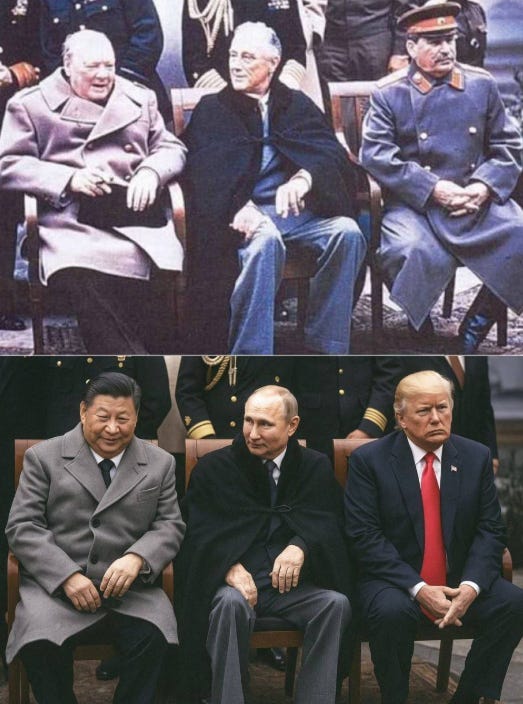
Every regime eventually acquires a court portraitist, and the current fashion in Moscow is to paint the president as a grandmaster who sees twelve moves ahead, while the current fashion in the West is to paint him as a gambler who got lucky. I prefer a duller instrument than either brush: the risk report. Strip away the iconography and ask what any desk head asks of a trader before giving him more limit. Does he understand the book? Does he cut losers? Can he bluff without blinking? Does he have one edge that is genuinely world-class? And does he still want to come to work in the morning? Run that checklist honestly, across Moscow, Washington and Brussels alike, and the answers are more interesting than either the hagiography or the caricature. By that standard the boldest trade of the decade, the move into open confrontation with the West in early 2022, was neither genius nor madness. It was a wild bluff that happened to get filled.
Start with how history actually prices. Economics, sociology and political science describe the field of play, but they count in medians and deciles, which tells you the probable shape of events and very little about which branch gets realised. Any situation has three or four scenarios with real weight, each above 3–5%, and a long tail sharing the remaining few percent. Nobody cares about the tail until it starts gathering mass, which is more or less how the market treated Hormuz until 28 February. Personality operates inside that distribution. It is the same reason football is better entertainment than basketball: the more often the favourite loses, the better the game, and history, whatever the textbooks claim, plays a lot more like football.
The standard Western line on Putin is that he is a brilliant tactician with no strategy. That is lazy, and the record says so. State corporations were built in the mid-2000s, and after 2014 came import substitution, for a reason most commentators skip: in 2014 Russia imported 40–60% of many food categories, dairy among them, and nobody, China included, would have stood behind Moscow. Going further then would have meant empty shelves within months. By 2022 most of those gaps were closed, and the hinge of the whole position was energy. Buyers in the non-West stayed out of sanctions because they had nowhere else to buy oil and gas. That is strategy in the sense a trader means it: you build the inventory before you put on the position. Whether the position was worth putting on is a separate question, and the bill is still arriving.
Four years on, the lever still works, and Europe still pays for the privilege of complaining about it. EU gas storage stood at 70.5% on 14 November, according to Gas Infrastructure Europe, the lowest for that date since records began in 2011, with Germany at 57%. Dutch TTF has held above $1,000 per thousand cubic metres, and day-ahead power in Germany and France neared €350/MWh during the latest Dunkelflaute. Meanwhile the EU spent around €8.7bn on Yamal LNG in ten months, more than in all of 2025, weeks before its own ban takes effect on 1 January 2027. It may be the only sanctions regime in history that front-runs itself. Russia’s October oil and product export revenue came to $21.15bn by the IEA’s count, up 65% year on year on volumes 570 kb/d lower. But the windfall has a dependency that nobody in Moscow describes in these terms. As Gulf barrels returned, Argus had the Urals discount to Dated Brent out to $31 in the Baltic and $33 at Novorossiysk, the widest since April 2023, and India’s November crude intake through Hormuz, at about 2.1 mb/d, overtook its Russian imports at 1.8 mb/d. Strip out the rhetoric and Russia is simply long Gulf disruption.
The checklist itself is easiest to explain through art, of all things. Classical academic painting has five marks: mimesis, aesthetics, catharsis, uniqueness and a memorial function. Remove mimesis and you get Impressionism. Remove aesthetics and catharsis and you get the avant-garde. Remove uniqueness and you get conceptualism, which is left holding the memorial function alone. Remove that too, and you get NFTs, which nobody quite managed to sell. Leadership decomposes the same way. The first mark is plain intelligence, which sounds trivial until you remember how the public judges it. When the Paris salons opened to ordinary townspeople in the late 19th century, they assessed paintings by a single test, likeness to reality. Then Monet painted the same haystack a dozen times, orange, grey and white depending on the light, and the public was baffled. Crowd judgement drifts toward the median and below, which is worth bearing in mind every time a poll tells you what a leader is worth.
