

The Fighter Jet With No Engine
Generals and Armorers


I spent an evening this week with one of the long-form geostrategy podcasts I keep in rotation, the kind where a genial host lobs softball questions at a professional doom-forecaster and the doom-forecaster obliges at length, and the subject of the day was Palantir. Not the stock — nobody on that program prices options for a living — but Palantir as symbol: the supposed vanguard of a coming “digital dictatorship” that, according to the guest, missed its own historical window and is now essentially idling, a fighter jet with a beautiful wing and no engine. I don’t share the geopolitical framework wholesale, and I’m allergic to anyone who talks about civilizational destiny with a straight face, but buried in the rhetoric was a genuinely useful commodity-market thesis, and it’s the kind of thing that doesn’t show up in a sell-side note because sell-side notes are contractually obligated to be bullish about anything with “AI” in the title. So let me steal the skeleton and put my own flesh on it, because I think the framework travels well from geopolitics into freight, power, and metals, which is where I actually keep score.
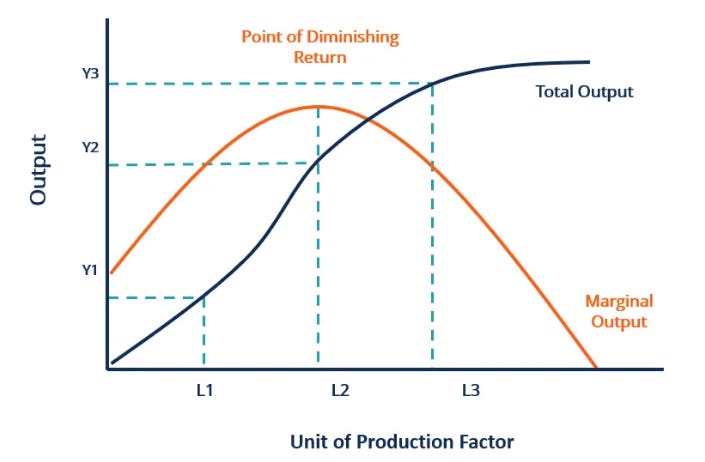
The core claim, stripped of its ideological wrapping, is that grand infrastructure projects requiring monopoly control only work if you can build the capacity in secret, before your rivals know the game exists, and then deploy it as a fait accompli. Nuclear weapons worked that way. Hypersonics worked that way, at least for the country that got there first. What doesn’t work is announcing the future to your competitors while you’re still building it, because that just invites everyone else onto the same S-curve, and an S-curve with twelve riders instead of one collapses the returns to all twelve. Every shipowner who has ever ordered newbuildings into a strong freight market has learned the hard way that the rate you’re chasing is the rate that existed before everyone else saw the same headline and ordered the same ships. Capacity announced in public is capacity that gets arbitraged away before it’s delivered. The Capesize orderbook cycles of the last twenty years are a monument to this exact failure mode: good economics attract fleet growth, fleet growth kills the economics that attracted it, repeat. Nobody builds a fleet in secret. That’s the whole tragedy of shipping capex — it’s the most public capital commitment in the world, visible in shipyard order data years before a single cargo moves, which is precisely why the returns get competed away on schedule, like clockwork, every cycle, forever.
Now overlay that onto the AI infrastructure buildout, because that’s where the podcast’s framework actually earns its keep. The thesis, is that the current wave of AI capex is not a secret weapons program, it’s a very loud, very public arms race that every major economy and every hyperscaler is running simultaneously, in full view of competitors, shareholders, and financial journalists, which by the logic above should guarantee that none of the participants gets the monopoly rent they’re implicitly underwriting their capex with. Six hundred billion dollars of announced spend, by the guest’s estimate — and I’ve seen higher, depending on whose depreciation schedule you trust — chasing a technology whose marginal returns are already showing the classic logistic curve rather than the exponential one everyone priced into their models three years ago. That’s not a controversial technical claim, by the way; you can see it in the token-cost-per-unit-of-capability numbers that keep getting quietly revised, and you can see it in the fact that model providers have started fighting over efficiency rather than raw scale, which is what an industry does once it discovers the easy gains are behind it. Pareto’s 80/20 doesn’t just apply to portfolio risk; it applies to any capital deployment curve, and the tell that you’ve crossed into the flat part of the S is always the same — you start spending 80% of the incremental dollar to capture 20% of the incremental gain, and everyone in the room starts talking about “efficiency” instead of “scale,” which is the corporate euphemism for “we’ve hit convexity in the wrong direction.”

Where this actually touches my book, and yours if you trade energy or metals, is upstream of the model layer entirely, in the physical inputs that don’t care whether the AI story is true. Compute needs power, power needs turbines and transformers and, increasingly, gas that isn’t going anywhere else, and turbines and transformers have lead times measured in years, not quarters. This is the one part of the AI trade that isn’t vibes. You can build a foundation model on borrowed capital and revised assumptions, but you cannot build a gigawatt of dispatchable generation on a press release. I’ve been watching US natural gas basis and heat-rate spreads in the regions with heavy data-center announcements the way I used to watch Baltic freight routes before a grain tender — not because I believe the AI capex narrative in full, but because the physical bottleneck is real regardless of whether the narrative eventually deflates. If you’re long gas turbine OEM backlog exposure, or long the gas basis in the right hub, you’re effectively short the same optionality the podcast host was worried about: you don’t need the “digital dictatorship” to actually arrive, you just need enough of the capex to get poured into concrete and steel before the market re-prices the terminal growth rate down to something sane. That’s a much easier trade to have a variant view on than “will superintelligence happen,” and it pays out even in the scenario where the answer is no.
The self-cannibalizing data problem the guest raised — models increasingly training on the output of other models rather than clean human material, producing a slow rot of hallucination that compounds with each generation — is worth taking seriously too, and not just as a technical curiosity. It’s a supply-quality problem, and traders who’ve spent time in physical commodities know exactly what a supply-quality problem does to a market: it doesn’t kill demand outright, it just forces a permanent discount into anything that can’t prove provenance, the way sour crude trades at a differential to sweet regardless of what the API gravity spec sheet says the theoretical arbitrage should be. I’d expect the same thing to eventually happen to model output — a bifurcation between providers who can credibly claim clean training data and everyone else, with the clean-data providers commanding the premium the way Brent commands its premium over a basket of blended, less-provenanced grades. Whether that differential shows up as a licensing fee, a subscription tier, or simply which model an enterprise client trusts enough to put into a regulated workflow, I don’t know yet, but the analogy to grade differentials in physical oil markets feels closer to right than the “AGI is coming” framework most of the industry is still trading off.
There’s also a labor-market argument buried in the discussion that I think gets underweighted by people who only read the technology coverage. The claim was, essentially, that most mature economies are carrying enormous amounts of what the guest called “office plankton,” administrative headcount accumulated during a management-structure buildout that happened decades ago and never got pruned, and that AI is less a genuine productivity revolution than a socially acceptable pretext for doing layoffs that were overdue anyway, dressed up as inevitability rather than as ordinary cost discipline. I find that more persuasive than most AI-productivity research I’ve read this year, honestly, because it doesn’t require you to believe anything about model capability at all — it only requires you to believe that management teams, given a plausible external narrative, will use it to do what they wanted to do regardless. And if that’s the real driver, the second-order effects run through consumer discretionary spend and freight demand for goods long before they run through anything you’d call “AI adoption” in a survey. Fewer office workers with disposable income eventually shows up in softer diesel demand for the delivery vans and softer container volumes for the goods they used to buy on their lunch break, and that’s a much more mundane, much more tradeable consequence than the civilizational framing suggests. I don’t have a clean position expressing this view yet — it’s more of a watch-item, something I want to see confirmed in a few more quarters of white-collar layoff data before I’d risk capital on the freight-demand read-through — but it’s the kind of thing worth keeping on the whiteboard.
The framing that the AI buildout represents a strategic failure because it wasn’t kept secret long enough to secure a monopoly is however a premature argument to make. I think that gets the game theory backwards for anyone who isn’t trying to run a world government, which is, mercifully, almost nobody in my client base. A public, competed, over-invested capex race is bad news for the equity holders of the individual companies doing the overspending — the returns get arbitraged down exactly as the shipping analogy predicts — but it’s very good news for the suppliers of the inputs that every competitor needs regardless of who wins the model war. This is the oldest trick in commodity investing and it’s worked in every gold rush since the actual gold rush: you don’t bet on which miner strikes it rich, you sell them the pickaxes, and in this cycle the pickaxes are turbines, transformers, high-voltage cable, and the gas and uranium that feed the turbines. Public arms races are terrible for the generals and wonderful for the armorers, and I’d rather hold the armorer’s paper than try to underwrite which general wins. If you want the equivalent options-market language for it: the individual AI labs are all long a very expensive, very theta-heavy call option on a payoff that keeps getting pushed further out the curve every time a new efficiency plateau shows up, while the physical-input suppliers are effectively short volatility and collecting the premium regardless of whether any single option ever finishes in the money. I know which side of that book I’d rather be on heading into winter contracting season.
The Chinese dumping-strategy point deserves a paragraph of its own because it’s the one place where the geopolitics and the trading floor actually agree without much translation required. The observation was that China’s usual playbook — enter a market with an inferior but cheap product, undercut on price until competitors exit, then raise prices once the field is clear — works beautifully for commoditized manufactured goods and fails for genuinely frontier technology, because frontier technology requires continuous breakthrough capability that a copy-and-undercut strategy structurally can’t produce once the environment it was copying has been priced to zero. I think that’s broadly correct, and I think you can see the empirical version of it already in solar panels, EV batteries, and now increasingly in shipbuilding, where Chinese yards have taken order-book share not through frontier engineering but through financing terms and government-subsidized cost structures that Korean and Japanese yards can’t match on price alone. It has been devastating for Korean and Japanese newbuild pricing power, and I’d expect the same dynamic in semiconductor equipment eventually, but it is very much not the same thing as China winning the AI capability race outright — dumping wins market share, it doesn’t win the technology frontier, and conflating the two is a mistake I see institutional clients make constantly when they ask me whether Chinese AI chips are “catching up.” Catching up on cost and catching up on frontier capability are different races with different finish lines, and only one of them is amenable to a subsidy check.
Where I land, is something close to this: don’t trade the AI narrative directly, because the narrative is a public, competed, over-leveraged capex race whose individual winners are genuinely unknowable and whose aggregate spend is already showing the flat part of the logistic. Trade the inputs instead — power, gas basis in constrained hubs, transformer and turbine OEM backlog, the metals that go into high-voltage infrastructure, and the labor-market softening that a management-friendly AI narrative is quietly enabling regardless of whether the underlying models ever get materially better than they are today. That’s a thesis that survives being wrong about the interesting part. If AGI arrives on schedule, the power grid still needed rebuilding and the turbines still needed ordering years in advance. If AGI stalls out on the plateau the token-cost data already hints at, the power grid still needed rebuilding, because data centers that plateau at current capability still run twenty-four hours a day drawing load. Either way the armorer gets paid, and I’d rather structure a position around the scenario that’s true in both branches of the tree than around the scenario that requires me to have a confident view on superintelligence.