


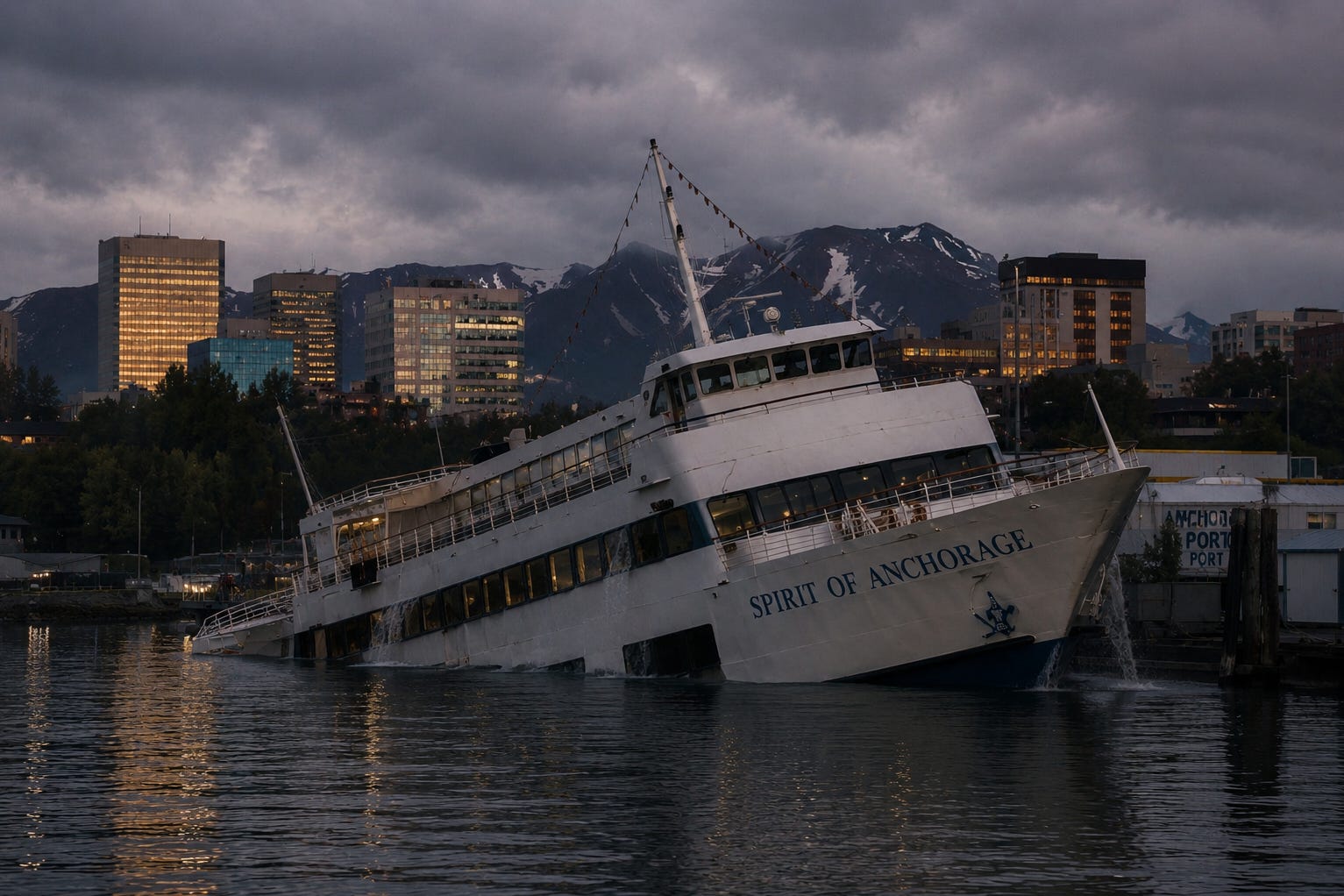
There was, briefly, a thing called the Spirit of Anchorage. You may remember it — the warm, hopeful aroma that wafted out of Alaska a few weeks ago, when the “leader of the free world” and the leader of the “not-particularly-free world” stood next to each other and gave everyone the impression that something resembling a deal was being warmed up in the back kitchen. Markets liked it. Brent backed off. The distillate crack obediently breathed out. People who had bought calls on Gasoil out of pure superstition quietly closed them and pretended they had always been in the spread instead. The Spirit of Anchorage is now officially deceased.
There was, briefly, a thing called the Spirit of Anchorage. You may remember it — the warm, hopeful aroma that wafted out of Alaska a few weeks ago, when the “leader of the free world” and the leader of the “not-particularly-free world” stood next to each other and gave everyone the impression that something resembling a deal was being warmed up in the back kitchen.
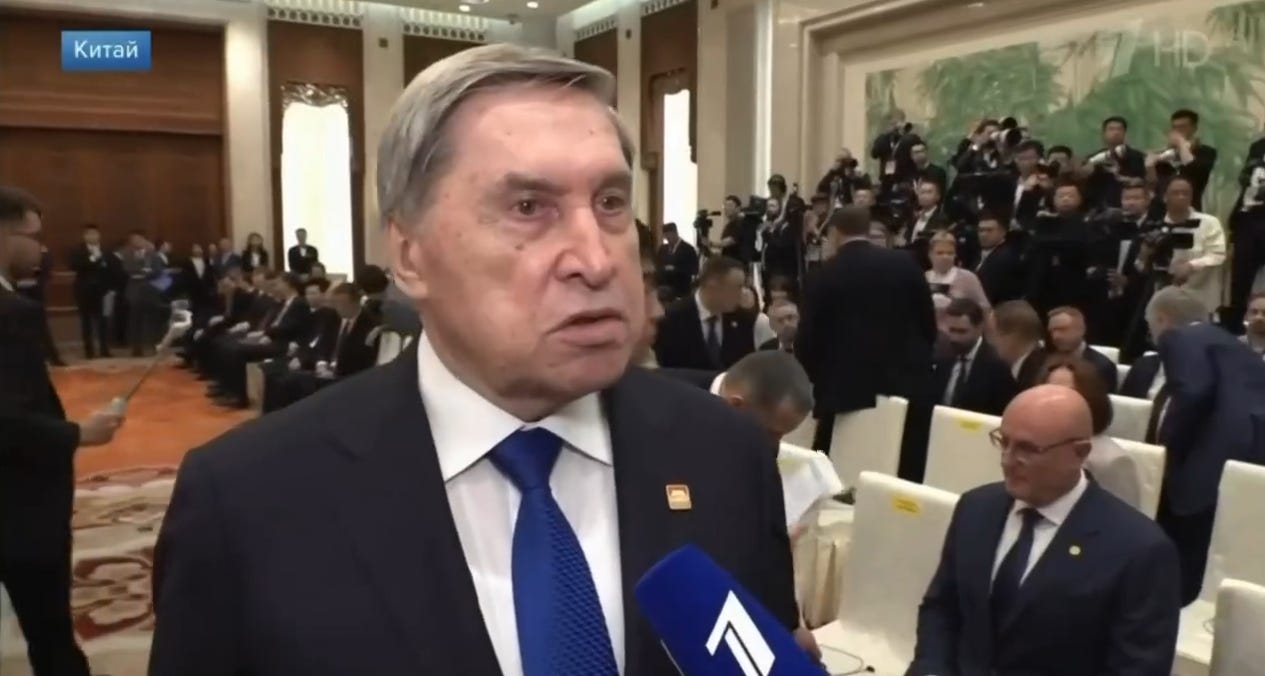
Time of death: somewhere between when a Chinese state-media correspondent, with the kind of smile you reserve for ex-spouses at funerals, asked Yuri Ushakov on camera what had replaced the Spirit of Anchorage — was it now the Spirit of Beijing? — and the moment Ushakov, visibly performing surgery on his own face, replied that he had never said anything about a Spirit of Anchorage in the first place. A man, in other words, denying the existence of a ghost while standing in the room where it died. Beautiful work. Stanislavski would have applauded. The thing that came out of Tianjin was not a communiqué in the dull post-Cold-War sense, the kind you skim for the word “concern” and then file under “billable.” It was a nuclear cocktail of language that, if you read it carefully, looks like a declaration of intent. Indivisible security. New strategic security architecture. Global governance. Opposition to the formation of military blocs. A pointed nod to the Thucydides Trap, which is the kind of reference you only deploy when you have already finished deciding which side of it you are on. They called the Americans a dying hegemon, more or less in those words, and then suggested that maybe, just maybe, states should stop being told how to live by other states. This is presented as multipolarity. It is, in fact, the polite version of “we two have decided, and the rest of you can read about it in the morning paper.” Trump and Xi did not jointly mug Putin in Anchorage; Xi and Putin jointly took Trump’s lunch in Tianjin, and Witkoff and Kushner — your favorite proximity-merchants — were promptly dispatched to Moscow to explain to the Kremlin chess club, in person, that the freelance career of certain intermediaries had reached a natural endpoint.
Now, the Spirit of Anchorage had served a particular purpose. It had bought the West time. While someone in Moscow was busy not finishing off the Ukrainian energy system at the pace they had been finishing it off a few weeks earlier — out of some sentimental commitment to not spoiling the mood at the talks — the other side of the table found a critical pressure point on the Russian economy and started squeezing. Drone strikes on refineries, on the shadow fleet, on the bits of infrastructure that turn barrels into bid–offer. The sort of campaign that a person sitting in front of a wallboard understands intuitively: you do not need to hedge every basis, you just need to put a credible threat on the one your counterparty cannot afford to lose. That was the West’s discovery. Cheap drones, expensive infrastructure, asymmetric payoff. The kind of trade structure a vol desk would write home about. And it worked, in the sense that for the first time in this war, the Kremlin started displaying body language that was not pure stone-faced kayfabe. Not capitulation, but recognition — which, in the language of options, is what happens when realized vol finally meets implied.
What Tianjin did, mechanically, was take that pressure point and announce that it will be closed. Not by negotiation. Not by a frowny eyebrow. By what the speaker on the original transcript, with characteristic Soviet-mechanical precision, called Кирзач — the kirza boot — landing squarely between the two legs of Trump’s wishbone stance. One foot in Ukraine, one foot in the Middle East, and a soft middle that the boot is, allegedly, about to find. The thesis, stripped of the smoking-room theatrics, is straightforward: Russia has been informed, by whomever one gets informed by in these structures, that escalation discipline has been outsourced for long enough, that the ladder of escalation is now to be climbed, and that the rung in question is one most Western capitals had quietly stopped believing in. A single tactical nuclear demonstration, somewhere in the Baltics. Not Kiev, not Lvov — striking Ukraine with that instrument would prove nothing the West needs to know. The point of the demonstration would not be to win a battle but to retire an institution, namely Article 5 of NATO, by demonstrating, in real time and in front of cameras, that the institution does not produce the response it advertises on the tin. The argument runs: hit Riga, hit Tallinn, hit a place with low population density and high symbolic charge, sit back, and wait. If the response is the kind of strongly worded statement Mr. Rutte has been workshopping this week, the alliance is over. If the response is genuine, kinetic and reciprocal — well, then a much larger conversation begins, but the people in charge of the boot are, in this telling, betting the entire chip stack that it does not.
