



At quarter past nine on a Friday morning I emailed my clearer with what I considered a perfectly reasonable proposal. Comrade, I wrote, let’s bid some four million dollars for those sweet, sweet six-month US Treasuries at 4.43%. Ten minutes later the reply came back with the exquisite courtesy of a man who holds both a CFA and our margin. He had been under the impression, he said, that I utmost despised the US Treasury not less than four weeks past. Notwithstanding my fleeting contempt, he would see how they tightened up later; for now they were offered at a 4.15 discount, 4.295%. I answered that the line between hatred and love is a thin red line. He replied with four words, which I have stolen for the title of this piece. Betwixt profit and principle.
The irritating thing about a good counterparty is that he is usually right, and the irritating thing about this exchange is that we both were. A few weeks ago I was, on any fair reading, rude about the US Treasury, about what it does with the dollar and to whom. None of that has changed. What has also not changed is that cash sitting in a clearing account earns nothing, and a six-month bill pays a little over four percent for the privilege of lending to the very institution I was rude about. Principle is a level. It is what you think of the thing. Profit is a slope. It is what happens to you when the thing moves. You can hold a firm view on the level and still trade the slope, and a remarkable share of this industry is run by people doing exactly that, most of whom would deny it at dinner. My bid, for the record, was not a serious attempt to buy the market. A 182-day bill at a 4.15 discount prices at about 97.90 and yields roughly 4.30% on a bond-equivalent basis. At the 4.43% I asked for, the same bill would be worth about 97.84, some 13.5 basis points through the offer, or roughly $2,500 cheaper on four million dollars. That is not much money, and that is rather the point. Thirteen and a half basis points is the precise distance between how I felt about the US Treasury four weeks ago and how I feel about its six-month paper this morning. It is the price at which I would like to trade, set just far enough from the price at which I can to let me keep my dignity. Principle, it turns out, is not a refusal to deal. It is a limit order.
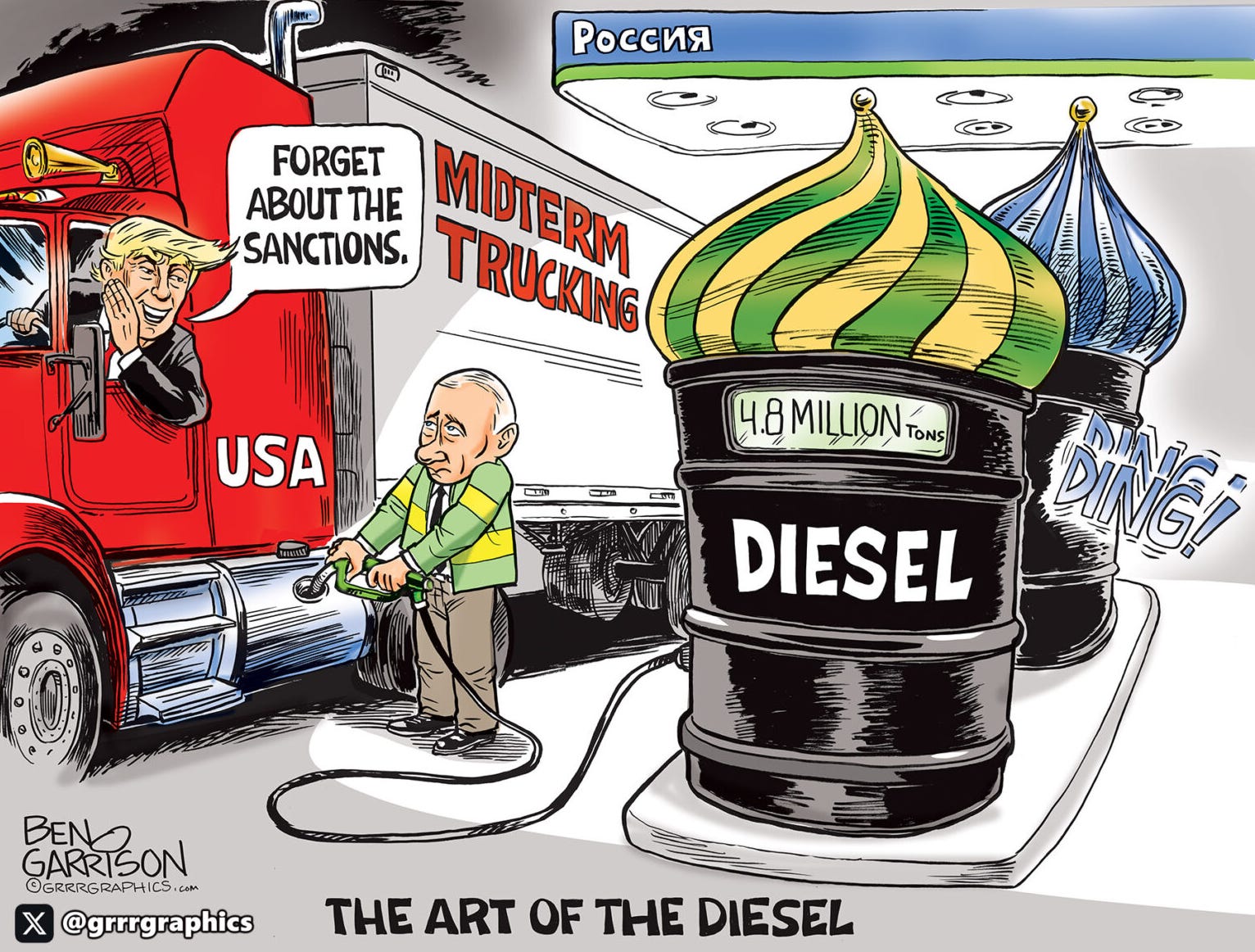
I mention all this because, on the very same Friday, the very same Treasury was conducting a much larger version of the same negotiation, with more zeros and considerably less self-awareness. While I was haggling over thirteen basis points with my clearer, the US Treasury Department issued a general license allowing Russian diesel back onto the world market. Cargoes loaded from that day are exempt from US sanctions until April 2027. Similar easing was granted in March and April, when the war with Iran first choked Hormuz, but those waivers ran for the standard thirty days. This is the first since the invasion of Ukraine to run longer, and it arrived after the Treasury Secretary had earlier ruled out exactly this kind of move. The license followed a phone call between Donald Trump and Vladimir Putin, after which the President announced a schedule worthy of a physical trader’s dream: more than 300,000 tonnes of diesel immediately, 500,000 tonnes in November, a million tonnes immediately thereafter, and three million tonnes within a short period of time after that. The White House did not say who would pay, when the fuel would arrive, or whether the November barrels would land before the election on the third.
Now hold that against what the same administration was doing four weeks ago, which happens to be exactly when my clearer remembers me being so rude about it. Last month the President signed a sweeping Russia sanctions law: measures against officials, banks and the shadow fleet of tankers, a ban on new US investment in Russia and on dealing in Russian sovereign debt, and tariffs of up to 100% on the five largest importers of Russian oil and gas. That is principle, written into statute and signed with a flourish. Four weeks later the national average diesel price is $6.23 a gallon, having touched a record $6.52 on the twenty-second of September, an election is less than a month away, and the President’s stated greatest priority is lower prices for farmers, ranchers and truckers. That is profit, or at least its political equivalent. Kiev noticed the gap immediately. Zelenskyy called it a weak decision and wrote that gifts to Putin will not bring peace. He is not wrong that it is a gift. He is perhaps wrong to be surprised. In my experience, principle that has not yet been tested against a $6.52 diesel print is not principle. It is an opening offer.
The physical market, meanwhile, has a few questions the press release did not answer. The first is where the diesel is supposed to come from. Russia has restricted its own diesel exports since July, because Ukrainian drones have done to its refineries roughly what the sanctions law was meant to do to its banks, and the IEA reckons Russian diesel output is down about 30%. Moscow’s response to the license was instant: the authorities say they are starting to lift the export restrictions immediately, ahead of the planned schedule. That tells you everything about how long a principle survives once a dollar buyer appears. Three months of protecting the domestic market, unwound within hours of the phone call. But lifting a ban does not refill a refinery. The paperwork has changed; the crude units hit by drones have not, and a country that was short enough to ban exports in July has to find the surplus somewhere. The second is scale. Add up the President’s schedule and you get about 4.8 million tonnes, which at 7.45 barrels to the tonne is some 36 million barrels, or roughly nine days of US distillate demand, delivered over an unspecified period by an unnamed counterparty to an unidentified buyer. The immediate 300,000 tonnes is about three LR2 cargoes, or 2.2 million barrels, which is roughly half of what the United States burns in a single day. Diesel futures dipped on the headline, which is what futures do with headlines. Whether the dip survives contact with the loading programme at Primorsk is another question entirely.
There is, however, a second reading of that export ban, and for a derivatives desk it is the more interesting one. Alexander Novak, the deputy prime minister who runs the Russian energy complex, has said more than once in recent weeks that there is no diesel shortage inside Russia, and that Moscow might lift the ban if the domestic market moved into surplus. The harvest, which is what eats Russian diesel in late summer, is in, and by official accounts it is about the size of last year’s. Russia has long produced far more diesel than it consumes. Warsaw tells a different story: the Polish foreign minister cites his embassy as saying Moscow has had to cut gasoline and diesel sales in the city by half. The truth probably sits somewhere between a Kremlin talking point and a Polish one. But if Novak is even half right, the ban was never only about feeding combines. It was an option Moscow held on the American pump price, struck in July and carried through the summer, and on Friday it exercised it in exchange for sanctions relief. It is also worth remembering where the shortage actually comes from. Russia is a large diesel exporter, but it is not the reason the world is short. The Gulf is. Even a full return of Russian barrels would treat the symptom, not the fracture.
Half a day of consumption will not move the pump price in any way a trucker would notice, and the White House surely knows it. The deal is not really about the barrels. It is about who gets blamed for the price. It is the second suspension of Russia sanctions this year, after the crude waiver at the height of the Iran war in March, and it means that for the first time since 2022 Russian diesel is headed for the US domestic market, which is in a genuine energy crisis with prices still near their historic highs. The Iran campaign has done nothing for the pump price, so other levers have to be found, and the most useful lever in an election month is a list of people to blame. The Democrats obliged within hours, accusing the White House of selling out Ukraine to cling on through the vote, with a tone the Yiddish would describe as a gevalt. According to Axios, Trump has repeatedly asked Zelenskyy to stop striking Russian refineries because of what the strikes are doing to diesel prices, and Kiev has repeatedly said no. Ukrainian officials have reportedly read some of Washington’s language as a hint that intelligence sharing could be switched off if the campaign continues. That is a remarkable thing to read alongside a license whose usefulness depends entirely on those refineries producing a surplus. The diesel deal is as much a message to Kiev as it is a trade with Moscow. The Europeans, whose officials were in Florida negotiating with the Trump team as the news broke, can expect their share of the blame in due course.
The Democrats are in the more awkward position. They can be as outraged as they like about the United States buying diesel from Russia, but the electorate cares a great deal more about the price at the pump than about speeches on the need to stand with Kiev, and the White House knows how to play that. The license is unlikely to save the election. It may, however, stop the slide in the President’s approval ratings, and in a market for political capital that is falling, a stop-loss is worth paying for. It is, once again, the same trade I was doing with my clearer: hold the principle in public, and quietly work the bid where it actually gets filled. And there is a third party to this negotiation who was not on the call. According to The Wall Street Journal, the largest US independent refiners are heading into third-quarter results expected to beat a second quarter that was already close to a record. Wall Street is looking for particularly strong numbers from Valero, Marathon Petroleum and Phillips 66, all three of which posted their best profits since the war in Ukraine began in the second quarter. The mechanism is not complicated. Disruption in the Middle East and the loss of part of Russia’s product exports have shrunk the world’s supply of diesel, gasoline and jet, while the Gulf Coast keeps running and keeps exporting. That is the rare combination every refiner prays for and almost never gets: strong demand and constrained global supply at the same time. While other regions scramble for whatever cargoes they can find, American refiners sell into them at exceptional margins. Which makes the diesel license a curious piece of policy. Its stated aim is to bring down the pump price, and the only way it can do that is by narrowing the very crack spread that is printing those record quarters. Washington has, in effect, chosen the trucker over the refiner and the pump over Kiev, and it has done so with sanctions it signed a month ago. Principle against Moscow, profit for Houston and relief for Main Street cannot all be had at once, and on the ninth of October the Treasury picked its order of priority. There is even a pleasing circularity in it for me personally. Some fraction of the tax on that third quarter ends up servicing the very six-month bills I was bidding for that morning. I despise the issuer, I buy its paper, its refiners sell diesel to the ships whose fuel I hedge, and now it is licensing Russian barrels to compete with them. The line is very thin indeed.
For anyone who hedges distillates for a living, the useful way to think about the license is as an option. The Treasury has, for free, written the market a call on Russian diesel that runs to April 2027. The exercise decision does not sit in Washington. It sits in Moscow, and it depends on whether Russian refineries can produce a surplus, whether the domestic market holds up now that the Kremlin has rushed to lift its own export restrictions, and whether Kiev’s drones agree. That is a binary, not a gradient. As I argued in The Barrel That Broke the Model, when the distillate market is this tight the crack spread is a better instrument than flat price Brent, and its distribution is lumpy rather than smooth. A license that either delivers millions of tonnes or delivers nothing is exactly the kind of switch that gives the gasoil crack a second hump. The forward curve will price Friday’s news as gradual relief. The options market should price it as a decision someone else gets to make, and that can be reversed by a single drone over a single refinery.
The Barrel That Broke the Model

There is a particular kind of market complacency that only becomes visible in retrospect — the kind where participants price a risk premium as temporary, mean-reverting, and fundamentally tradeable, right up until the moment the physical reality underneath it makes the premium structural. We are living through exactly that transition in the distillate complex right now, and the speed at which the consensus is updating is, charitably, not impressive. But there is a second failure happening simultaneously, one layer up the analytical stack, and it is this: even the traders who have correctly identified that something unusual is happening in the physical market are misreading what the options market is telling them about it. The volatility smile on Brent is not a directional forecast. It has never been a directional forecast. Understanding what it actually encodes — and what the current shape of the ICE Brent June 2026 term structure is screaming in particular — is the difference between a hedge book that survives this cycle and one that explains itself to a risk committee.
Put the three parties side by side and the pattern is hard to miss. Washington holds the principle of sanctions and trades it for cents a gallon before an election. Moscow held the principle of supplying its own market first and traded it within hours of the phone call, while conceding nothing on the principle it actually cares about. By the Kremlin’s own readout of the same call, Putin told Trump that Kiev’s strikes had disrupted any immediate return to trilateral talks, and that Moscow would consider when negotiations might resume. Diesel is for sale. The war is not. The refiners hold the principle of energy security and collect for it in third-quarter margins. None of them refuses to deal. Each of them places a limit order, a little away from the market, close enough to get filled and far enough to keep its dignity. Principle in this business is rarely a wall. It is a spread.
Betwixt profit and principle there is, as I told my clearer, only a thin red line, and on a trading desk that line has a name. It is the bid-offer spread. Washington’s is measured in cents per gallon, Moscow’s in the hours it took to drop its own export ban, Houston’s in dollars of crack. Mine, it turns out, was measured in an email.
You have bought four million dollars of the bill maturing on the eighth of April 2027, it read, at a 4.161 discount, a price of 97.954 and a yield of 4.307%, for value on the thirteenth. Not 4.43%. A shade better than where he first offered them, and a little over twelve basis points worse than where my principle wanted them, which on four million dollars comes to roughly $2,300. That is the exact price of my contempt for the US Treasury, and I have paid it in full. Settlement, he added, is one day later than usual, because Monday commemorates, or commiserates, Christopher Columbus’s discovery of the Americas five hundred and thirty-four years ago. A man who sailed west on someone else’s money, in the name of faith, looking for spices, and found a continent he could sell instead. Profit and principle have been travelling together on that route ever since. Mine settles on Tuesday.